
The Politics of Murmurin
Vainqueur the DragonThis flow traces how Vainqueur's private rules become a public constitution through treaties, exemptions, labor policies, and monster inclusion.
increasing Bearing strength in each event
 decreasing
Bearing strength in each eventdecreasingThe First Commandment
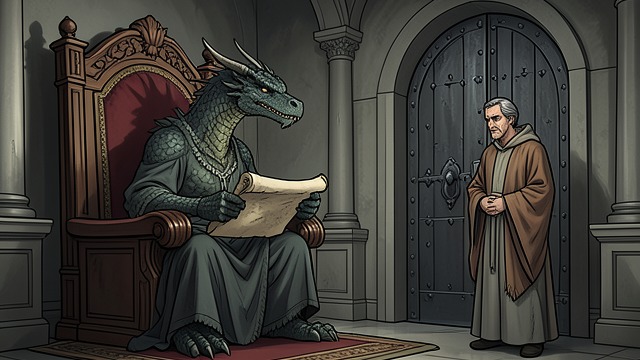
The First Commandment
No Taxes
Vainqueur declares that no treasure tax will be levied in his empire. He replaces taxation with cattle tribute, preserving the appearance of principle while retaining extraction.
Dragon Governance
The policy reflects the Emperor's central belief that taxes are theft when they separate a dragon from wealth. His state begins as an ideological projection of his private resentments.
Murmurin's constitution is born from personal greed.
Death Service

Death Service
Employment Beyond Death
Vainqueur orders that all minions dying in his service be reanimated as sentient Undead. Service becomes permanent, and death loses its power to end employment.
Loyalty and Coercion
The policy can be read as care because it promises continuity, or as exploitation because it denies release. Murmurin's society accepts both interpretations at once.
The empire's compassion is inseparable from its appetite for labor.
The Gardemagne Treaty
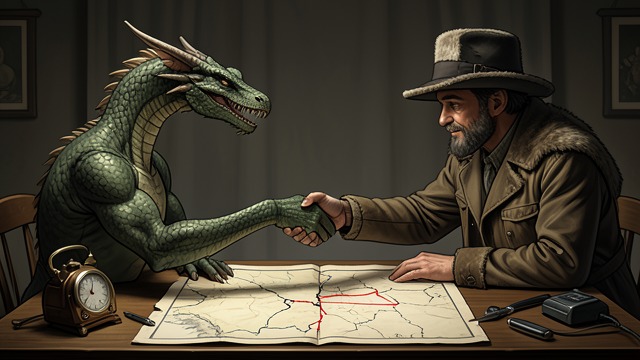
The Gardemagne Treaty
Recognition Through Necessity
Roland Gardemagne recognizes Vainqueur's dominion because the dragon has destroyed Maure and controls territory no conventional army wants to govern.
Legitimacy as Bargain
The treaty exchanges nonaggression and mutual protection for political recognition. Vainqueur receives an empire, while Gardemagne gains a powerful frontier ally without paying the full cost of occupation.
Both sides call the arrangement friendship because it is useful.
The Monster State
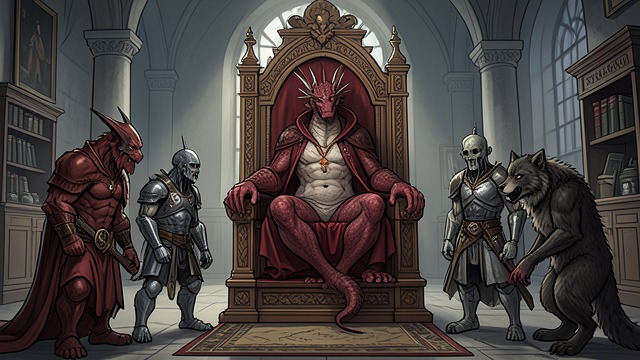
The Monster State
Inclusion by Necessity
Murmurin welcomes monsters excluded elsewhere, including Demons, Undead, Mimics, and Werewolves. Their differences become manageable through work, military service, and shared dependence on the Emperor.
A New Civil Order
The state does not abolish hierarchy; it relocates it. Vainqueur remains at the top, but the subjects below him gain protection, markets, and political identity.
Monster Civilization emerges from pragmatic coexistence rather than idealism.
The Ishfania Principle

The Ishfania Principle
Greed as Law
Vainqueur defines Ishfania as a realm where greed is legal, religion is unrestricted, and no one pays taxes to human rulers. The policy attracts both marginalized monsters and powerful supernatural corporations.
Freedom's Contradiction
The empire offers refuge from old authorities while placing every subject under Vainqueur's appetite and personal law. Its freedom is genuine for some and exploitative for others.
Murmurin becomes a political experiment that no conventional kingdom can easily absorb.
after Vainqueur's self-coronation
during the imperial reforms
during Vainqueur’s Bragging Day
after Maure's defeat
at the conclusion of the treaty negotiations
